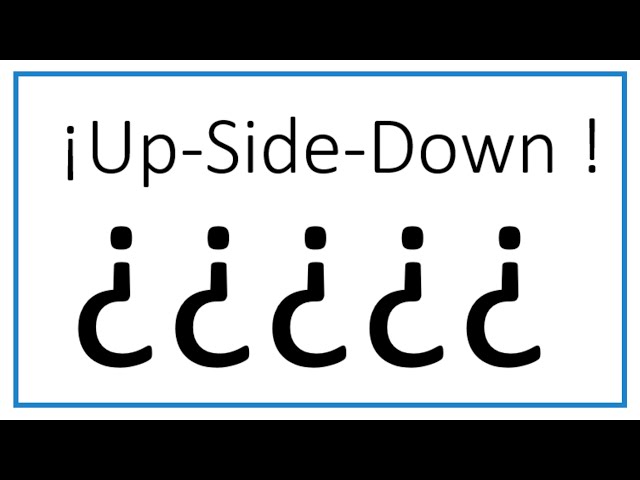
The upside-down query mark, often known as a reversed query mark or an inverted query mark, is a punctuation mark that’s utilized in quite a lot of languages, together with Spanish, Portuguese, and Turkish. It’s usually used to point a rhetorical query, a query that’s requested for impact somewhat than for a solution, or a query that’s meant to be humorous. The upside-down query mark may also be used to point a query that’s being requested not directly or that’s being requested in a tentative or unsure method.
The upside-down query mark is a useful gizmo for writers and audio system who need to add emphasis or nuance to their questions. It may also be used to create a way of thriller or suspense. In some instances, the upside-down query mark may even be used to point sarcasm or irony.
The upside-down query mark has an extended and assorted historical past. It’s thought to have originated within the Center Ages, when it was utilized by scribes to point a query that was being requested in a respectful or deferential method. Over time, the upside-down query mark got here for use extra broadly, and it’s now a standard punctuation mark in lots of languages.
the other way up query mark copy paste
The the other way up query mark, often known as a reversed query mark or an inverted query mark, is a punctuation mark that’s utilized in quite a lot of languages, together with Spanish, Portuguese, and Turkish. It’s usually used to point a rhetorical query, a query that’s requested for impact somewhat than for a solution, or a query that’s meant to be humorous. The upside-down query mark may also be used to point a query that’s being requested not directly or that’s being requested in a tentative or unsure method.
- Rhetorical questions
- Humorous questions
- Oblique questions
- Tentative questions
- Unsure questions
- Spanish language
- Portuguese language
- Turkish language
- Center Ages
The upside-down query mark has an extended and assorted historical past. It’s thought to have originated within the Center Ages, when it was utilized by scribes to point a query that was being requested in a respectful or deferential method. Over time, the upside-down query mark got here for use extra broadly, and it’s now a standard punctuation mark in lots of languages. Right this moment, the upside-down query mark is utilized in quite a lot of contexts, from formal writing to casual dialog. It’s a versatile punctuation mark that can be utilized so as to add emphasis, nuance, or humor to a query.
Rhetorical questions
A rhetorical query is a query that’s requested for impact somewhat than for a solution. Rhetorical questions are sometimes used to make a degree, to emphasise a degree, or to influence the reader or listener to agree with the speaker’s perspective. Rhetorical questions may also be used to create a way of thriller or suspense.
The upside-down query mark is commonly used to point a rhetorical query. It’s because the upside-down query mark is a non-standard punctuation mark, and its use can due to this fact be interpreted as a deliberate try to attract consideration to the query being requested. As well as, the upside-down query mark can create a way of thriller or suspense, which might be acceptable for rhetorical questions.
Listed here are some examples of rhetorical questions with upside-down query marks:
- Who can say what the long run holds?
- How can we anticipate to resolve our issues if we do not even attempt?
- Why can we at all times make the identical errors?
These rhetorical questions are all designed to make a degree or to emphasise a degree. They don’t seem to be meant to be answered, however somewhat to impress thought and reflection. The upside-down query mark helps to attract consideration to those questions and to emphasise their significance.
Rhetorical questions are a strong instrument that can be utilized to make a degree, to emphasise a degree, or to influence the reader or listener to agree with the speaker’s perspective. The upside-down query mark is a non-standard punctuation mark that can be utilized to point a rhetorical query. Its use may also help to attract consideration to the query being requested and to create a way of thriller or suspense.
Humorous questions
The upside-down query mark is commonly used to point a humorous query. It’s because the upside-down query mark is a non-standard punctuation mark, and its use can due to this fact be interpreted as a deliberate try to attract consideration to the query being requested. As well as, the upside-down query mark can create a way of shock or incongruity, which might be humorous.
-
Exaggeration
The upside-down query mark can be utilized to magnify the humor of a query. For instance, the query “Are you kidding me?” may very well be written as “uoy ddik I ?” This exaggeration could make the query extra humorous by making it appear extra absurd or ridiculous.
-
Irony
The upside-down query mark can be utilized to create irony. For instance, the query “Is that this a joke?” may very well be written as “siht a ekOJ sI ?” This irony might be humorous as a result of it creates a way of distinction between the anticipated and the precise.
-
Sarcasm
The upside-down query mark can be utilized to point sarcasm. For instance, the query “Oh, actually?” may very well be written as “yllaer ,hO ?” This sarcasm might be humorous as a result of it conveys a way of disbelief or contempt.
-
Puns
The upside-down query mark can be utilized to create puns. For instance, the query “What is the distinction between a hippo and a Zippo?” may very well be written as “oppiz a dna oppih a ween fferenceid eht s’tahW ?” This pun might be humorous as a result of it performs on the phrases “hippo” and “Zippo” and the truth that the upside-down query mark makes the query appear to be it’s the other way up.
These are only a few examples of how the upside-down query mark can be utilized to create humorous questions. The upside-down query mark is a flexible punctuation mark that can be utilized so as to add humor to any query.
Oblique questions
An oblique query is a query that’s reported not directly, somewhat than straight. Oblique questions are sometimes used to make a query extra well mannered or to keep away from sounding confrontational. Oblique questions may also be used to report questions that have been requested in a distinct language.
The upside-down query mark is commonly used to point an oblique query. It’s because the upside-down query mark is a non-standard punctuation mark, and its use can due to this fact be interpreted as a deliberate try to attract consideration to the query being requested. As well as, the upside-down query mark can create a way of tentativeness or uncertainty, which might be acceptable for oblique questions.
Listed here are some examples of oblique questions with upside-down query marks:
- I’m wondering should you may assist me.
- I am unsure what time the assembly is.
- Have you learnt the place the lavatory is?
These oblique questions are all reported not directly. They don’t seem to be meant to be answered straight, however somewhat to convey the gist of the query that was requested. The upside-down query mark helps to attract consideration to those questions and to emphasise their tentativeness or uncertainty.
Oblique questions are a useful gizmo for writers and audio system who need to add politeness or tentativeness to their questions. The upside-down query mark is a non-standard punctuation mark that can be utilized to point an oblique query. Its use may also help to attract consideration to the query being requested and to emphasise its tentativeness or uncertainty.
Tentative questions
A tentative query is a query that’s requested in a hesitant or unsure method. Tentative questions are sometimes used to precise a speaker’s insecurity of their data or to keep away from sounding confrontational. Tentative questions may also be used to melt the impression of a query or to make it extra well mannered.
The upside-down query mark is commonly used to point a tentative query. It’s because the upside-down query mark is a non-standard punctuation mark, and its use can due to this fact be interpreted as a deliberate try to attract consideration to the query being requested. As well as, the upside-down query mark can create a way of tentativeness or uncertainty, which might be acceptable for tentative questions.
Listed here are some examples of tentative questions with upside-down query marks:
- I am unsure should you may assist me, however…
- Have you learnt the place the lavatory is?
- May you please inform me what time the assembly is?
These tentative questions are all requested in a hesitant or unsure method. The upside-down query mark helps to attract consideration to those questions and to emphasise their tentativeness or uncertainty.
Tentative questions are a useful gizmo for writers and audio system who need to add politeness or tentativeness to their questions. The upside-down query mark is a non-standard punctuation mark that can be utilized to point a tentative query. Its use may also help to attract consideration to the query being requested and to emphasise its tentativeness or uncertainty.
Unsure questions
Unsure questions are a kind of query that’s requested in a hesitant or unsure method. They’re usually used to precise a speaker’s insecurity of their data or to keep away from sounding confrontational. Unsure questions may also be used to melt the impression of a query or to make it extra well mannered.
The upside-down query mark is commonly used to point an unsure query. It’s because the upside-down query mark is a non-standard punctuation mark, and its use can due to this fact be interpreted as a deliberate try to attract consideration to the query being requested. As well as, the upside-down query mark can create a way of tentativeness or uncertainty, which might be acceptable for unsure questions.
Listed here are some examples of unsure questions with upside-down query marks:
- I am unsure should you may assist me, however…
- Have you learnt the place the lavatory is?
- May you please inform me what time the assembly is?
These unsure questions are all requested in a hesitant or unsure method. The upside-down query mark helps to attract consideration to those questions and to emphasise their tentativeness or uncertainty.
Unsure questions are a useful gizmo for writers and audio system who need to add politeness or tentativeness to their questions. The upside-down query mark is a non-standard punctuation mark that can be utilized to point an unsure query. Its use may also help to attract consideration to the query being requested and to emphasise its tentativeness or uncertainty.
Spanish language
The upside-down query mark is a punctuation mark that’s utilized in quite a lot of languages, together with Spanish. In Spanish, the upside-down query mark is used to point a rhetorical query, a query that’s requested for impact somewhat than for a solution. Rhetorical questions are sometimes used to make a degree, to emphasise a degree, or to influence the reader or listener to agree with the speaker’s perspective.
The upside-down query mark can be utilized in Spanish to point a query that’s being requested not directly or that’s being requested in a tentative or unsure method. Oblique questions are sometimes used to make a query extra well mannered or to keep away from sounding confrontational. Tentative questions are sometimes used to precise a speaker’s insecurity of their data or to keep away from sounding confrontational.
The upside-down query mark is a flexible punctuation mark that can be utilized so as to add emphasis, nuance, or humor to a query. It is a vital a part of the Spanish language and is utilized in quite a lot of contexts. By understanding the totally different makes use of of the upside-down query mark, you’ll be able to higher perceive the that means of Spanish textual content and talk extra successfully in Spanish.
Portuguese language
The upside-down query mark is a punctuation mark that’s utilized in quite a lot of languages, together with Portuguese. In Portuguese, the upside-down query mark is used to point a rhetorical query, a query that’s requested for impact somewhat than for a solution. Rhetorical questions are sometimes used to make a degree, to emphasise a degree, or to influence the reader or listener to agree with the speaker’s perspective.
The upside-down query mark can be utilized in Portuguese to point a query that’s being requested not directly or that’s being requested in a tentative or unsure method. Oblique questions are sometimes used to make a query extra well mannered or to keep away from sounding confrontational. Tentative questions are sometimes used to precise a speaker’s insecurity of their data or to keep away from sounding confrontational.
-
Rhetorical questions
Rhetorical questions are a standard use of the upside-down query mark in Portuguese. These questions are used to make a degree or to emphasise a degree, somewhat than to elicit a solution. For instance, the query “Por que voc est aqui?” (Why are you right here?) may very well be used to precise the speaker’s frustration or anger on the listener’s presence.
-
Oblique questions
Oblique questions are one other widespread use of the upside-down query mark in Portuguese. These questions are used to make a query extra well mannered or to keep away from sounding confrontational. For instance, the query “Voc poderia me dizer as horas?” (May you inform me the time?) may very well be used to ask somebody for the time in a extra well mannered method than the direct query “Que horas so?” (What time is it?).
-
Tentative questions
Tentative questions are additionally a standard use of the upside-down query mark in Portuguese. These questions are used to precise a speaker’s insecurity of their data or to keep away from sounding confrontational. For instance, the query “Ser que voc poderia me ajudar?” (May you assist me?) may very well be used to ask somebody for assist in a extra tentative method than the direct query “Voc pode me ajudar?” (Are you able to assist me?).
-
Different makes use of
Along with the makes use of described above, the upside-down query mark may also be utilized in Portuguese to point a query that’s being requested in a humorous or ironic method. For instance, the query “Voc est brincando?” (Are you kidding?) may very well be used to precise the speaker’s disbelief or sarcasm.
The upside-down query mark is a flexible punctuation mark that can be utilized so as to add emphasis, nuance, or humor to a query. It is a vital a part of the Portuguese language and is utilized in quite a lot of contexts. By understanding the totally different makes use of of the upside-down query mark, you’ll be able to higher perceive the that means of Portuguese textual content and talk extra successfully in Portuguese.
Turkish language
The Turkish language and the upside-down query mark copy paste are intently linked, because the upside-down query mark is a punctuation mark that’s used within the Turkish language to point a query. It’s also utilized in different languages, akin to Spanish and Portuguese, however it’s mostly related to Turkish.
-
Historical past
The upside-down query mark is assumed to have originated within the Ottoman Empire, the place it was utilized by scribes to point a query that was being requested in a respectful or deferential method. Over time, the upside-down query mark got here for use extra broadly in Turkish, and it’s now a typical punctuation mark within the language.
-
Utilization
The upside-down query mark is utilized in Turkish to point a query that’s being requested on to somebody. It’s also used to point a query that’s being requested not directly or that’s being requested in a tentative or unsure method.
-
Instance
Right here is an instance of how the upside-down query mark is utilized in Turkish:
“Naber?” (What’s up?)
On this instance, the upside-down query mark is used to point a query that’s being requested on to somebody. The query is casual and is used to greet somebody or to ask how they’re doing.
The upside-down query mark is a vital punctuation mark within the Turkish language. It’s used to point a query that’s being requested on to somebody, or a query that’s being requested not directly or that’s being requested in a tentative or unsure method. By understanding the totally different makes use of of the upside-down query mark, you’ll be able to higher perceive the that means of Turkish textual content and talk extra successfully in Turkish.
Center Ages
The Center Ages, often known as the medieval interval, was a historic interval that lasted from the fifth to the fifteenth century. It was a time of nice social, political, and spiritual change in Europe. The Center Ages is commonly seen as a interval of decline after the autumn of the Roman Empire, but it surely was additionally a time of nice innovation and progress. Probably the most vital improvements of the Center Ages was the event of the printing press, which led to the widespread dissemination of information and the rise of the Renaissance.
The upside-down query mark is a punctuation mark that’s utilized in quite a lot of languages, together with Spanish, Portuguese, and Turkish. It’s usually used to point a rhetorical query, a query that’s requested for impact somewhat than for a solution, or a query that’s meant to be humorous. The upside-down query mark can be used to point a query that’s being requested not directly or that’s being requested in a tentative or unsure method.
The connection between the Center Ages and the upside-down query mark is that the upside-down query mark is assumed to have originated within the Center Ages, when it was utilized by scribes to point a query that was being requested in a respectful or deferential method. Over time, the upside-down query mark got here for use extra broadly, and it’s now a typical punctuation mark in lots of languages.
The upside-down query mark is a flexible punctuation mark that can be utilized so as to add emphasis, nuance, or humor to a query. It is a vital a part of the historical past of punctuation and continues for use in quite a lot of languages as we speak.
Ceaselessly Requested Questions About Upside-Down Query Mark Copy Paste
The upside-down query mark is a punctuation mark that’s utilized in quite a lot of languages, together with Spanish, Portuguese, and Turkish. It’s usually used to point a rhetorical query, a query that’s requested for impact somewhat than for a solution, or a query that’s meant to be humorous. The upside-down query mark may also be used to point a query that’s being requested not directly or that’s being requested in a tentative or unsure method.
Query 1: What’s the origin of the upside-down query mark?
The upside-down query mark is assumed to have originated within the Center Ages, when it was utilized by scribes to point a query that was being requested in a respectful or deferential method. Over time, the upside-down query mark got here for use extra broadly, and it’s now a typical punctuation mark in lots of languages.
Query 2: How is the upside-down query mark utilized in totally different languages?
The upside-down query mark is utilized in quite a lot of methods in numerous languages. In Spanish, it’s usually used to point a rhetorical query. In Portuguese, it’s used to point a rhetorical query or a query that’s being requested not directly or that’s being requested in a tentative or unsure method. In Turkish, it’s used to point a query that’s being requested on to somebody.
Query 3: What are among the totally different ways in which the upside-down query mark can be utilized?
The upside-down query mark can be utilized so as to add emphasis, nuance, or humor to a query. It may also be used to point a rhetorical query, a query that’s being requested not directly, or a query that’s being requested in a tentative or unsure method.
Query 4: Is the upside-down query mark a proper or casual punctuation mark?
The upside-down query mark is mostly thought of to be an off-the-cuff punctuation mark. It’s usually utilized in social media, textual content messages, and different casual writing. Nonetheless, it may also be utilized in formal writing in sure contexts, akin to when indicating a rhetorical query.
Query 5: What are among the advantages of utilizing the upside-down query mark?
The upside-down query mark could be a great tool for writers and audio system who need to add emphasis, nuance, or humor to their questions. It may also be used to point a rhetorical query, a query that’s being requested not directly, or a query that’s being requested in a tentative or unsure method.
Query 6: What are among the challenges of utilizing the upside-down query mark?
One of many challenges of utilizing the upside-down query mark is that it isn’t at all times acknowledged by all software program and gadgets. This will result in the query mark being displayed the other way up or in no way. One other problem is that the upside-down query mark might be tough to learn for some individuals, particularly these with dyslexia or different studying difficulties.
By understanding the origin, makes use of, and challenges of utilizing the upside-down query mark, you should use this punctuation mark successfully so as to add emphasis, nuance, or humor to your writing.
Ideas for Utilizing the Upside-Down Query Mark
The upside-down query mark is a punctuation mark that can be utilized so as to add emphasis, nuance, or humor to a query. It’s usually utilized in Spanish, Portuguese, and Turkish, but it surely may also be utilized in English in sure contexts.
Listed here are 5 suggestions for utilizing the upside-down query mark successfully:
Tip 1: Use the upside-down query mark to point a rhetorical query.
A rhetorical query is a query that’s requested for impact somewhat than for a solution. The upside-down query mark can be utilized to point a rhetorical query by including emphasis to the query.
Instance: “Are you able to imagine this?”
Tip 2: Use the upside-down query mark to point a query that’s being requested not directly.
An oblique query is a query that’s not requested on to somebody. The upside-down query mark can be utilized to point an oblique query by making the query extra well mannered or tentative.
Instance: “I used to be questioning should you may assist me with one thing.”
Tip 3: Use the upside-down query mark to point a query that’s being requested in a tentative or unsure method.
A tentative query is a query that’s requested in a hesitant or unsure method. The upside-down query mark can be utilized to point a tentative query by making the query much less assertive.
Instance: “I am unsure if that is the precise method to do that, however…”
Tip 4: Use the upside-down query mark so as to add humor to a query.
The upside-down query mark can be utilized so as to add humor to a query by making the query extra surprising or stunning.
Instance: “Are you kidding me?”
Tip 5: Use the upside-down query mark sparingly.
The upside-down query mark is a strong punctuation mark, but it surely must be used sparingly. Utilizing the upside-down query mark too usually could make your writing tough to learn and perceive.
By following the following pointers, you should use the upside-down query mark successfully so as to add emphasis, nuance, or humor to your writing.
Conclusion
The upside-down query mark, often known as a reversed query mark or an inverted query mark, is a punctuation mark that’s utilized in quite a lot of languages, together with Spanish, Portuguese, and Turkish. It’s usually used to point a rhetorical query, a query that’s requested for impact somewhat than for a solution, or a query that’s meant to be humorous. The upside-down query mark may also be used to point a query that’s being requested not directly or that’s being requested in a tentative or unsure method.
The upside-down query mark is a flexible punctuation mark that can be utilized so as to add emphasis, nuance, or humor to a query. It is a vital a part of the historical past of punctuation and continues for use in quite a lot of languages as we speak. By understanding the totally different makes use of of the upside-down query mark, you’ll be able to higher perceive the that means of textual content and talk extra successfully.
Youtube Video: