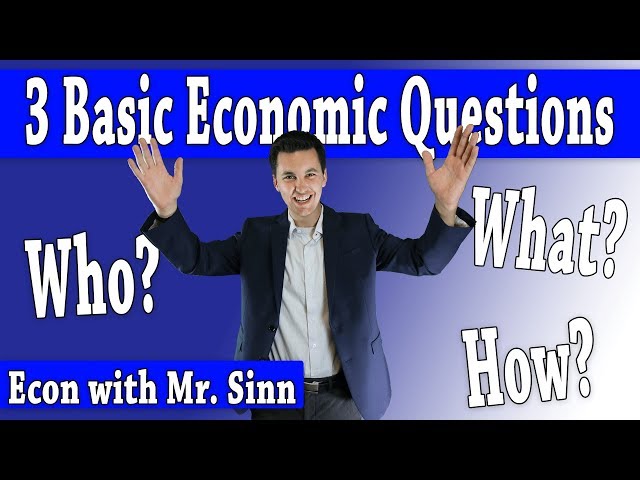
3 Primary Financial Questions are basic to the examine of economics. They’re:
- What items and companies ought to be produced?
- How ought to these items and companies be produced?
- For whom ought to these items and companies be produced?
The solutions to those questions decide the construction of an economic system and the allocation of its sources.
The three Primary Financial Questions are vital for a number of causes:
- They supply a framework for analyzing financial programs.
- They assist to establish the important thing points that policymakers should tackle.
- They can be utilized to match completely different financial programs.
3 Primary Financial Questions
The three Primary Financial Questions are basic to the examine of economics. They’re normative questions that tackle the allocation of scarce sources. The solutions to those questions can be utilized to match completely different financial programs and to establish the important thing points that policymakers should tackle.
- What (items and companies) ought to be produced?
- How (sources) ought to these items and companies be produced?
- For whom (people or teams) ought to these items and companies be produced?
- How a lot of every good or service ought to be produced?
- When ought to these items and companies be produced?
- The place ought to these items and companies be produced?
- By whom ought to these items and companies be produced?
- Why ought to these items and companies be produced?
- Beneath what circumstances ought to these items and companies be produced?
These questions are interrelated and can be utilized to research a variety of financial points. For instance, the query of what items and companies ought to be produced can be utilized to research the effectivity of the market system. The query of how items and companies ought to be produced can be utilized to research the function of presidency within the economic system. The query of for whom items and companies ought to be produced can be utilized to research the distribution of revenue and wealth.
The three Primary Financial Questions are a strong software for understanding how economies work. They can be utilized to research a variety of financial points and to establish the important thing points that policymakers should tackle.
What (items and companies) ought to be produced?
The query of what items and companies ought to be produced is a basic financial query. It’s intently associated to the opposite two primary financial questions: how ought to these items and companies be produced, and for whom ought to they be produced?
The reply to the query of what ought to be produced isn’t at all times easy. In a market economic system, the allocation of sources is set by the interplay of provide and demand. Nonetheless, there are some items and companies which are thought of to be important for the well-being of society, similar to meals, clothes, and shelter. These items and companies are sometimes supplied by the federal government or by non-profit organizations.
The choice of what to provide can be influenced by the supply of sources. A rustic with considerable pure sources could select to focus on producing and exporting these sources. A rustic with a big labor drive could select to focus on producing labor-intensive items and companies.
The query of what to provide is a fancy one which has no simple solutions. Nonetheless, it is a crucial query to think about, because it has a major influence on the financial well-being of a society.
How (sources) ought to these items and companies be produced?
The query of how items and companies ought to be produced is a basic financial query. It’s intently associated to the opposite two primary financial questions: what items and companies ought to be produced, and for whom ought to they be produced?
- Effectivity: Effectivity is the power to provide items and companies with the least quantity of waste. There are numerous elements that may have an effect on the effectivity of manufacturing, such because the know-how used, the talents of the employees, and the group of the manufacturing course of.
- Price: The price of manufacturing is the full quantity of sources which are used to provide a superb or service. The price of manufacturing might be divided into two major classes: mounted prices and variable prices. Fastened prices are prices that don’t change with the extent of manufacturing, similar to the price of hire or gear. Variable prices are prices that do change with the extent of manufacturing, similar to the price of uncooked supplies or labor.
- High quality: The standard of a superb or service is a measure of how properly it meets the wants of customers. High quality might be affected by quite a few elements, such because the supplies used, the workmanship, and the design.
- Sustainability: Sustainability is the power to provide items and companies with out harming the surroundings. Sustainability is a rising concern, because the world’s inhabitants continues to develop and the demand for sources will increase.
The choice of easy methods to produce items and companies is a fancy one which includes quite a few trade-offs. Producers should think about the effectivity, price, high quality, and sustainability of their manufacturing processes to be able to make choices which are in the very best pursuits of their prospects and their companies.
For whom (people or teams) ought to these items and companies be produced?
The query of for whom items and companies ought to be produced is a basic financial query that’s intently associated to the opposite two primary financial questions: what items and companies ought to be produced and how ought to they be produced. The reply to this query has a major influence on the construction of an economic system and the distribution of its output.
In a market economic system, the allocation of products and companies is set by the interplay of provide and demand. Nonetheless, the federal government can play a task in making certain that important items and companies can be found to all residents, no matter their potential to pay. For instance, the federal government could present subsidies for meals, housing, and healthcare. The federal government may regulate costs to make sure that important items and companies are reasonably priced for everybody.
The query of for whom items and companies ought to be produced can be related to the difficulty of financial inequality. In lots of nations, the hole between the wealthy and the poor is rising wider. That is due partially to the truth that the rich are in a position to seize a disproportionate share of the economic system’s output. Because of this, many individuals are unable to afford primary requirements like meals, clothes, and shelter.
The query of for whom items and companies ought to be produced is a fancy one which has no simple solutions. Nonetheless, it is a crucial query to think about, because it has a major influence on the well-being of society.
Conclusion
The query of for whom items and companies ought to be produced is a vital part of the three primary financial questions. It’s a complicated query that has no simple solutions, however it is a crucial query to think about, because it has a major influence on the well-being of society.
How a lot of every good or service ought to be produced?
The query of how a lot of every good or service ought to be produced is a basic financial query that’s intently associated to the opposite two primary financial questions: what items and companies ought to be produced and the way ought to they be produced?
The reply to this query has a major influence on the allocation of sources in an economic system. If an excessive amount of of a superb or service is produced, then sources will probably be wasted. If too little of a superb or service is produced, then customers will be unable to get the products and companies they want.
There are a variety of things that may have an effect on the amount of products and companies which are produced, together with:
- The provision of sources
- The extent of know-how
- The dimensions of the inhabitants
- The tastes and preferences of customers
The federal government can play a task in figuring out how a lot of every good or service is produced. For instance, the federal government can present subsidies to encourage the manufacturing of sure items or companies. The federal government can even regulate the costs of products and companies to make sure that they’re reasonably priced for customers.
The query of how a lot of every good or service ought to be produced is a fancy one which has no simple solutions. Nonetheless, it is a crucial query to think about, because it has a major influence on the effectivity and fairness of an economic system.
Conclusion
The query of how a lot of every good or service ought to be produced is a vital part of the three primary financial questions. It’s a complicated query that has no simple solutions, however it is a crucial query to think about, because it has a major influence on the well-being of society.
When ought to these items and companies be produced?
The query of “When ought to these items and companies be produced?” is intently associated to the three primary financial questions of “What ought to be produced?”, “How ought to they be produced?”, and “For whom ought to they be produced?”.
- Matching Provide and Demand: One vital issue to think about when figuring out when to provide items and companies is matching provide and demand. If items are produced too early, they might not be in demand but, leading to waste and spoilage. Conversely, if items are produced too late, customers could have already turned to different choices, resulting in misplaced gross sales and income.
- Seasonality and Perishability: The timing of manufacturing can be essential for perishable items and people which are topic to seasonal demand. For instance, vegetables and fruit ought to be produced throughout their peak season to make sure freshness and high quality. Equally, winter clothes ought to be produced upfront of the chilly climate season to fulfill client demand.
- Manufacturing Capability and Lead Occasions: The manufacturing course of itself can even affect the timing of manufacturing. Producers want to think about their manufacturing capability and lead occasions when planning manufacturing schedules. Lead occasions discuss with the time it takes to provide a superb or service, from the acquisition of uncooked supplies to the completed product.
- Financial Circumstances and Forecasting: Exterior financial circumstances, similar to financial development, inflation, and client confidence, can even influence the timing of manufacturing. Companies must forecast future demand primarily based on financial indicators and market traits to make knowledgeable choices about when to provide items and companies.
By contemplating these elements, companies can optimize their manufacturing schedules to fulfill client, reduce waste, and maximize earnings. Finally, the query of “When ought to these items and companies be produced?” is an integral a part of the three primary financial questions, serving to companies and economies allocate sources effectively and successfully.
The place ought to these items and companies be produced?
The query of “The place ought to these items and companies be produced?” is intently related to the “3 primary financial questions” of “What ought to be produced?”, “How ought to they be produced?”, and “For whom ought to they be produced?”. It is a crucial consideration for companies and economies, as the placement of manufacturing can considerably influence effectivity, prices, and general financial outcomes.
One of many key elements to think about when figuring out the place to provide items and companies is the supply of sources. For instance, a rustic with considerable pure sources could select to focus on producing and exporting these sources. Conversely, a rustic with a big labor drive could select to focus on producing labor-intensive items and companies.
One other vital issue to think about is the price of manufacturing. This contains elements similar to labor prices, transportation prices, and vitality prices. Companies will usually select to provide items and companies in places the place the price of manufacturing is lowest. This may help them to scale back their prices and enhance their earnings.
The query of the place to provide items and companies can be intently associated to the difficulty of sustainability. Producing items and companies in a sustainable manner may help to scale back environmental impacts and preserve pure sources. For instance, companies could select to provide items and companies in places the place they’ll use renewable vitality sources or recycle waste supplies.
By contemplating the elements of useful resource availability, manufacturing prices, and sustainability, companies and economies could make knowledgeable choices about the place to provide items and companies. This may help to enhance effectivity, cut back prices, and promote sustainable financial development.
In conclusion, the query of “The place ought to these items and companies be produced?” is an integral a part of the “3 primary financial questions.” By contemplating the elements mentioned above, companies and economies could make knowledgeable choices about the place to provide items and companies. This may help to enhance effectivity, cut back prices, and promote sustainable financial development.
By whom ought to these items and companies be produced?
The query of “By whom ought to these items and companies be produced?” is a vital part of the “3 primary financial questions” of “What ought to be produced?”, “How ought to they be produced?”, and “For whom ought to they be produced?”. Figuring out who ought to produce items and companies has vital implications for the effectivity, fairness, and general functioning of an economic system.
- Possession and Management: This side refers back to the possession and management of the technique of manufacturing, similar to land, capital, and labor. Totally different financial programs have completely different approaches to possession and management, starting from personal possession to public possession or cooperatives.
- Labor Market Dynamics: The query of “By whom” additionally pertains to the function of labor within the manufacturing course of. Elements similar to ability ranges, wages, and dealing circumstances can affect who’s concerned in manufacturing and the way items and companies are produced.
- Entrepreneurship and Innovation: The personal sector, usually pushed by entrepreneurship and innovation, performs a major function in producing items and companies. Understanding the elements that encourage or hinder entrepreneurship may help form insurance policies that promote financial development and innovation.
- Function of Authorities: Governments can affect who produces items and companies by way of rules, subsidies, and public possession. The extent of presidency involvement in manufacturing varies relying on the financial system and the precise trade.
In conclusion, the query of “By whom ought to these items and companies be produced?” is intricately related to the “3 primary financial questions.” Answering this query requires an understanding of possession and management, labor market dynamics, entrepreneurship and innovation, and the function of presidency. By contemplating these elements, policymakers and economists can develop insurance policies that promote environment friendly and equitable manufacturing of products and companies, contributing to general financial well-being.
Why ought to these items and companies be produced?
The query of “Why ought to these items and companies be produced?” is intently associated to the “3 primary financial questions” of “What ought to be produced?”, “How ought to they be produced?”, and “For whom ought to they be produced?”. Understanding the explanations behind the manufacturing of products and companies gives insights into the priorities, values, and targets of an economic system.
- Client Demand and Market Worth: Items and companies are produced to fulfill client needs and wishes. Market demand, pushed by client preferences and buying energy, performs a basic function in figuring out what ought to be produced. Producers reply to market indicators to allocate sources and create items and companies that align with client demand.
- Financial Progress and Growth: The manufacturing of products and companies contributes to financial development and improvement. By offering employment alternatives, producing income, and stimulating technological developments, manufacturing actions drive financial growth and enhance residing requirements.
- Social Welfare and Public Items: Sure items and companies are important for the well-being of society however might not be adequately supplied by the market. Public items, similar to clear air, nationwide protection, and public schooling, are produced by governments or non-profit organizations to make sure their availability to all residents.
- Environmental Sustainability and Useful resource Allocation: The manufacturing of products and companies should think about environmental sustainability and useful resource allocation. Producers and policymakers attempt to attenuate environmental impacts and make sure that pure sources are used effectively and responsibly.
In conclusion, the query of “Why ought to these items and companies be produced?” is intertwined with the “3 primary financial questions.” Understanding the explanations behind manufacturing choices helps us analyze financial programs, consider useful resource allocation, and assess the general influence of manufacturing actions on society and the surroundings.
Beneath what circumstances ought to these items and companies be produced?
The query of “Beneath what circumstances ought to these items and companies be produced?” is intently intertwined with the “3 primary financial questions” of “What ought to be produced?”, “How ought to they be produced?”, and “For whom ought to they be produced?”. Understanding these circumstances is essential for environment friendly and equitable manufacturing and distribution of products and companies in an economic system.
Firstly, the circumstances of manufacturing straight influence the effectivity and value of manufacturing items and companies. Elements similar to the supply of sources, technological developments, and infrastructure play an important function in figuring out the feasibility and affordability of manufacturing. By contemplating the optimum circumstances for manufacturing, economies can allocate sources extra successfully and reduce waste.
Secondly, the circumstances of manufacturing additionally affect the standard and security of products and companies. Establishing and adhering to acceptable requirements, rules, and high quality management measures make sure that customers obtain merchandise that meet their expectations and don’t pose any well being or security dangers.
Thirdly, the circumstances of manufacturing have vital implications for environmental sustainability and social duty. By contemplating elements similar to using renewable sources, air pollution management, and truthful labor practices, economies can promote sustainable and moral manufacturing practices that shield the surroundings and uphold social values.
In conclusion, understanding the query of “Beneath what circumstances ought to these items and companies be produced?” is important for analyzing financial programs, evaluating manufacturing processes, and making certain that items and companies are produced effectively, responsibly, and in a fashion that advantages each customers and society as an entire.
Incessantly Requested Questions on “3 Primary Financial Questions”
This part addresses some widespread questions and misconceptions surrounding the “3 Primary Financial Questions.”
Query 1: What precisely are the “3 Primary Financial Questions”?
Reply: The “3 Primary Financial Questions” are a basic framework in economics that explores the important thing choices that societies should make concerning the allocation of scarce sources. These questions are “What items and companies ought to be produced?”, “How ought to these items and companies be produced?”, and “For whom ought to these items and companies be produced?”
Query 2: Why are these three questions thought of “primary” in economics?
Reply: These questions are thought of primary as a result of they kind the inspiration for understanding how economies function and the way sources are distributed. They supply a place to begin for analyzing financial programs and insurance policies, and so they assist us to know the complicated interactions between producers, customers, and governments.
Query 3: How do the “3 Primary Financial Questions” assist us perceive real-world financial points?
Reply: By analyzing these questions, economists and policymakers can achieve insights into:
- The effectivity and effectiveness of manufacturing strategies
- The distribution of revenue and wealth
- The function of presidency within the economic system
- The influence of financial choices on the surroundings and society as an entire
Query 4: Are the “3 Primary Financial Questions” universally relevant to all financial programs?
Reply: Whereas the questions themselves are common, the solutions could differ relying on the precise financial system in place. Totally different financial programs have completely different mechanisms for allocating sources and addressing these questions, similar to markets, central planning, or a mix of each.
Query 5: How have the “3 Primary Financial Questions” advanced over time?
Reply: The “3 Primary Financial Questions” have remained the cornerstone of financial evaluation for hundreds of years, however their interpretation and utility have advanced alongside the event of financial thought. Modern financial discussions usually develop on these primary questions to think about points similar to sustainability, fairness, and the function of know-how.
Query 6: What are a number of the limitations of the “3 Primary Financial Questions”?
Reply: Whereas the “3 Primary Financial Questions” present a helpful framework, they don’t supply full solutions to all financial issues. They don’t, for instance, tackle problems with financial development, inflation, or worldwide commerce. Moreover, the solutions to those questions usually contain complicated trade-offs and worth judgments that require additional evaluation.
Abstract
The “3 Primary Financial Questions” are a basic software for understanding how economies operate and the way sources are allotted. By analyzing these questions, we are able to achieve insights into a variety of financial points and insurance policies. Whereas their utility could differ throughout completely different financial programs and over time, these questions stay important for analyzing and addressing the challenges and alternatives confronted by societies.
Transition to the subsequent part:
The “3 Primary Financial Questions” present a basis for understanding economics. Within the subsequent part, we’ll discover a number of the key financial fashions that economists use to research and predict financial habits.
Understanding the “3 Primary Financial Questions”
The “3 Primary Financial Questions” present a basic framework for analyzing financial programs and useful resource allocation. By understanding these questions and their implications, we are able to achieve helpful insights into how economies function.
Tip 1: Take into account the Interconnections
The “3 Primary Financial Questions” are interconnected and affect one another. Choices made concerning what to provide, easy methods to produce, and for whom to provide have ripple results all through the economic system.
Tip 2: Analyze Alternative Prices
Each financial choice includes trade-offs, generally known as alternative prices. By understanding the chance prices related to completely different manufacturing and distribution strategies, we are able to make knowledgeable selections about useful resource allocation.
Tip 3: Study Market Mechanisms
Market mechanisms, similar to provide and demand, play a vital function in figuring out what, how, and for whom items and companies are produced. Analyzing these mechanisms helps us perceive how costs, manufacturing ranges, and consumption patterns are influenced.
Tip 4: Consider Authorities’s Function
Governments intervene within the economic system in varied methods, similar to by way of taxation, subsidies, and rules. Understanding the rationale behind these interventions helps us assess their influence on financial outcomes.
Tip 5: Take into account Financial Effectivity
Financial effectivity refers back to the optimum allocation of sources to realize most output and client satisfaction. Analyzing manufacturing and distribution strategies from an effectivity perspective may help us establish areas for enchancment.
Abstract
By making use of the following pointers and delving deeper into the “3 Primary Financial Questions,” we are able to improve our understanding of financial programs, make knowledgeable choices about useful resource allocation, and contribute to the general well-being of society.
Conclusion
The “3 Primary Financial Questions” of what, how, and for whom to provide kind a cornerstone of financial evaluation. These questions present a framework for understanding how economies allocate scarce sources and make choices that form the distribution of products and companies.
By analyzing these questions, economists and policymakers can achieve insights into the effectivity of manufacturing strategies, the equity of useful resource distribution, and the function of presidency within the economic system. The solutions to those questions have profound implications for financial development, social welfare, and environmental sustainability.
Understanding the “3 Primary Financial Questions” is important for anybody searching for to know how economies operate and easy methods to make knowledgeable choices about useful resource allocation. By persevering with to discover these questions, we are able to contribute to the event of extra equitable, sustainable, and affluent financial programs.
Youtube Video: