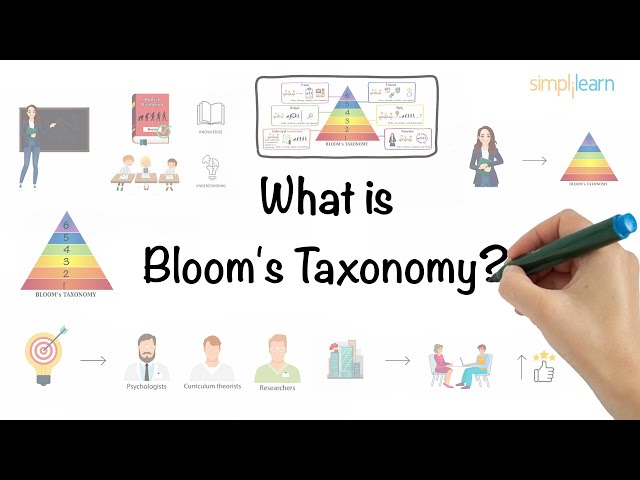
Bloom’s taxonomy of questions is a framework for classifying the totally different ranges of cognitive expertise concerned in questioning. It was developed by Benjamin Bloom in 1956 and has since change into a broadly used instrument in training.
Bloom’s taxonomy of questions is split into six ranges, every of which represents a special stage of cognitive ability. The degrees are:
- Information: Questions at this stage require college students to recall or acknowledge info.
- Comprehension: Questions at this stage require college students to know the that means of data.
- Utility: Questions at this stage require college students to use their information to new conditions.
- Evaluation: Questions at this stage require college students to interrupt down info into its part components.
- Synthesis: Questions at this stage require college students to place collectively info from totally different sources to create one thing new.
- Analysis: Questions at this stage require college students to make judgments concerning the worth of data.
Bloom’s taxonomy of questions is a great tool for academics as a result of it helps them to design questions which might be applicable for the extent of their college students’ cognitive expertise. It may additionally assist college students to develop their crucial considering expertise.
Bloom’s taxonomy of questions
Bloom’s taxonomy of questions is a framework for classifying the totally different ranges of cognitive expertise concerned in questioning. It was developed by Benjamin Bloom in 1956 and has since change into a broadly used instrument in training.
- Ranges: Bloom’s taxonomy of questions consists of six ranges, every representing a special stage of cognitive ability.
- Cognitive expertise: The taxonomy focuses on classifying the cognitive expertise required to reply questions, starting from easy recall to advanced analysis.
- Academic targets: Bloom’s taxonomy helps educators set clear and particular academic targets by defining the specified cognitive outcomes.
- Query stems: Every stage of the taxonomy is related to particular query stems that information academics in crafting efficient questions.
- Curriculum design: The taxonomy offers a framework for designing curricula and assessments that align with particular cognitive ranges.
- Scholar evaluation: Bloom’s taxonomy serves as a instrument for assessing scholar studying and understanding by evaluating their cognitive skills.
- Crucial considering: The taxonomy promotes crucial considering expertise by encouraging college students to have interaction in higher-order considering processes.
- Lifelong studying: Bloom’s taxonomy helps lifelong studying by offering a construction for people to develop their cognitive expertise all through their lives.
In abstract, Bloom’s taxonomy of questions is a precious instrument for educators and learners alike. It offers a scientific strategy to classifying cognitive expertise, designing efficient questions, and assessing scholar studying. By understanding and making use of the taxonomy, educators can foster the event of scholars’ crucial considering skills and promote lifelong studying.
Ranges
The six ranges of Bloom’s taxonomy of questions kind the inspiration of the taxonomy itself. Every stage represents a definite cognitive ability, starting from primary recall to advanced analysis. Understanding this hierarchical construction is essential for successfully making use of the taxonomy in academic contexts.
The degrees present a framework for educators to design questions that concentrate on particular cognitive expertise. By aligning questions with the suitable stage, academics can make sure that college students are challenged and supported of their studying. For example, knowledge-level questions take a look at college students’ capacity to recall info, whereas evaluation-level questions require them to make advanced judgments.
Furthermore, the degrees function a instrument for assessing scholar studying. By analyzing college students’ responses to questions at totally different ranges, educators can achieve insights into their cognitive strengths and areas for enchancment. This info can then be used to tailor instruction and supply focused help.
In abstract, the six ranges of Bloom’s taxonomy of questions are an integral part of the taxonomy. They supply a scientific strategy to classifying cognitive expertise, designing efficient questions, and assessing scholar studying. By understanding and making use of the degrees, educators can foster the event of scholars’ crucial considering skills and promote significant studying.
Cognitive expertise
The connection between cognitive expertise and Bloom’s taxonomy of questions is key to understanding the taxonomy’s objective and utility. Bloom’s taxonomy is a framework for classifying questions primarily based on the cognitive expertise they require to reply. These cognitive expertise vary from easy recall to advanced analysis, reflecting the totally different ranges of considering concerned in answering questions.
Cognitive expertise are the psychological skills that people use to amass, course of, and apply information. They embody a variety of processes, together with remembering, understanding, analyzing, making use of, evaluating, and creating. Bloom’s taxonomy offers a construction for organizing and classifying these cognitive expertise, making it a precious instrument for educators and learners alike.
By understanding the cognitive expertise required to reply questions at totally different ranges of Bloom’s taxonomy, educators can design questions that successfully goal particular studying targets. For instance, a query that requires college students to recall a reality falls on the information stage, whereas a query that requires college students to research and consider info falls on the greater ranges of the taxonomy. This enables educators to tailor their inquiries to the precise cognitive expertise they wish to develop of their college students.
In abstract, the connection between cognitive expertise and Bloom’s taxonomy of questions is important for understanding and making use of the taxonomy successfully. By aligning questions with the suitable cognitive expertise, educators can promote crucial considering, deep understanding, and significant studying.
Academic targets
The connection between academic targets and Bloom’s taxonomy of questions is key to efficient instructing and studying. Bloom’s taxonomy offers a framework for classifying academic targets primarily based on the cognitive expertise they require college students to reveal. By aligning academic targets with the suitable ranges of the taxonomy, educators can make sure that their instructing and evaluation practices are aligned with their meant studying outcomes.
-
Readability and specificity
Bloom’s taxonomy helps educators to set clear and particular academic targets by offering a typical language for describing the cognitive expertise that college students are anticipated to develop. This readability is important for efficient instructing and studying, because it permits each educators and college students to have a shared understanding of the specified outcomes. -
Cognitive rigor
Bloom’s taxonomy promotes cognitive rigor by encouraging educators to set targets that require college students to have interaction in higher-order considering expertise, comparable to evaluation, synthesis, and analysis. By difficult college students to suppose critically and creatively, educators might help them to develop the mental expertise they want to achieve college and past. -
Alignment with evaluation
Bloom’s taxonomy offers a framework for aligning academic targets with evaluation practices. By designing assessments that measure the cognitive expertise specified within the targets, educators can make sure that they’re precisely assessing scholar studying. This alignment helps to make sure that college students are given truthful and legitimate assessments of their progress. -
Differentiated instruction
Bloom’s taxonomy can be utilized to distinguish instruction by tailoring academic targets to the person wants of scholars. For instance, college students who’re struggling could have to deal with targets on the decrease ranges of the taxonomy, comparable to information and comprehension, whereas college students who’re prepared for tougher work could possibly deal with targets on the greater ranges, comparable to evaluation and analysis.
In abstract, the connection between academic targets and Bloom’s taxonomy of questions is important for efficient instructing and studying. By utilizing the taxonomy to set clear and particular targets, promote cognitive rigor, align evaluation with targets, and differentiate instruction, educators can create studying environments which might be conducive to scholar success.
Query stems
Inside Bloom’s taxonomy of questions, query stems function important instruments for educators to assemble questions that successfully goal particular cognitive expertise. These query stems are tailor-made to every stage of the taxonomy, offering steering in formulating questions that elicit the specified stage of considering from college students.
-
Cognitive Alignment
Query stems are fastidiously aligned with the cognitive expertise related to every stage of Bloom’s taxonomy. By utilizing applicable query stems, academics can make sure that their questions precisely assess the meant cognitive skills of scholars, selling significant engagement and understanding. -
Readability and Consistency
Particular query stems present readability and consistency in questioning practices. Standardized stems assist to eradicate ambiguity and make sure that college students clearly comprehend the duty at hand. This consistency fosters a shared understanding between educators and college students, enabling efficient communication and decreasing confusion. -
Greater-Order Pondering
Query stems encourage higher-order considering expertise by guiding college students past easy recall. By incorporating stems that promote evaluation, analysis, and synthesis, educators can problem college students to have interaction in crucial considering, problem-solving, and inventive considering. -
Scholar Engagement
Applicable query stems actively interact college students within the studying course of. When questions are framed utilizing participating and thought-provoking stems, college students usually tend to be motivated and invested of their responses. This engagement fosters a dynamic studying setting that helps deeper understanding and retention.
In abstract, query stems play a significant position in Bloom’s taxonomy of questions by offering steering for developing efficient questions that align with particular cognitive expertise, promote readability, encourage higher-order considering, and improve scholar engagement. By leveraging query stems successfully, educators can create a extra focused and interesting studying expertise for his or her college students.
Curriculum design
Throughout the framework of Bloom’s taxonomy of questions, curriculum design performs a pivotal position in aligning studying targets, instructing strategies, and evaluation methods with the meant cognitive ranges. The taxonomy serves as a information for educators to assemble curricula that progressively develop college students’ cognitive skills, fostering deep understanding and demanding considering.
By incorporating the taxonomy into curriculum design, educators can make sure that studying actions and assessments are tailor-made to particular cognitive ranges. For example, a curriculum designed forknowledgelevel outcomes would deal with actions that emphasize memorization and recall of info. Conversely, a curriculum designed foranalysislevel outcomes would come with actions that require college students to interrupt down info into its part components and determine relationships.
The alignment between curriculum design and Bloom’s taxonomy allows educators to create a cohesive studying expertise for college students. By matching instructing strategies and evaluation duties to the suitable cognitive ranges, educators can scaffold studying and supply college students with the mandatory help to realize higher-order considering expertise. This strategy promotes significant studying and helps college students develop the mental skills they want to achieve educational {and professional} settings.
In abstract, the connection between curriculum design and Bloom’s taxonomy of questions is important for creating efficient studying environments that foster cognitive improvement. By leveraging the taxonomy as a framework, educators can design curricula that align with particular cognitive ranges, guaranteeing that college students are challenged to suppose critically, clear up issues, and create new information.
Scholar evaluation
The connection between scholar evaluation and Bloom’s taxonomy of questions is key to efficient instructing and studying. Bloom’s taxonomy offers a framework for classifying the totally different ranges of cognitive expertise concerned in studying, and it may be used to design evaluation duties that measure college students’ understanding and talents at every stage.
One of many key advantages of utilizing Bloom’s taxonomy for evaluation is that it helps to make sure that college students are challenged to suppose at greater ranges. By designing evaluation duties that require college students to use, analyze, consider, and create information, educators can encourage college students to develop their crucial considering expertise and problem-solving skills.
One other advantage of utilizing Bloom’s taxonomy for evaluation is that it offers a typical language for discussing scholar studying. By utilizing the taxonomy to explain the cognitive expertise that college students are anticipated to reveal, educators can extra simply talk with one another about scholar progress and determine areas the place college students want further help.
In apply, Bloom’s taxonomy can be utilized to create a wide range of totally different evaluation duties, comparable to exams, quizzes, essays, initiatives, and shows. By aligning evaluation duties with the suitable ranges of Bloom’s taxonomy, educators can make sure that they’re precisely measuring scholar studying and offering college students with suggestions that’s significant and actionable.
Total, the connection between scholar evaluation and Bloom’s taxonomy of questions is important for efficient instructing and studying. By utilizing Bloom’s taxonomy to design evaluation duties, educators can problem college students to suppose at greater ranges, talk extra successfully about scholar progress, and supply college students with suggestions that’s significant and actionable.
Crucial considering
Throughout the framework of Bloom’s taxonomy of questions, crucial considering occupies a central place, because it represents the higher-order considering expertise that educators try to develop of their college students. The taxonomy promotes crucial considering by encouraging college students to have interaction in cognitive processes that transcend easy recall and comprehension. Via questions that require evaluation, analysis, and creation, college students are challenged to suppose critically, clear up issues, and generate new concepts.
The connection between Bloom’s taxonomy of questions and demanding considering is clear in the best way that the taxonomy’s ranges construct upon each other. The decrease ranges of the taxonomy, comparable to information and comprehension, present the inspiration for crucial considering expertise. College students should have the ability to recall and perceive info earlier than they’ll analyze, consider, and create new information. The upper ranges of the taxonomy, comparable to evaluation, analysis, and creation, require college students to have interaction in crucial considering processes to reveal their understanding.
For instance, a instructor who desires to evaluate college students’ crucial considering expertise may ask a query that requires them to research a historic occasion. College students would wish to make use of their information of the occasion to determine its causes and results, after which consider the totally different views on the occasion to kind their very own conclusions. This sort of query requires college students to have interaction in higher-order considering processes, comparable to evaluation, analysis, and synthesis, that are important for crucial considering.
The sensible significance of understanding the connection between Bloom’s taxonomy of questions and demanding considering is that it helps educators to design studying experiences that promote crucial considering expertise. By utilizing questions which might be aligned with the upper ranges of the taxonomy, educators can problem college students to suppose critically and develop the mental expertise they want to achieve college and past.
Lifelong studying
The connection between lifelong studying and Bloom’s taxonomy of questions lies within the taxonomy’s emphasis on growing higher-order cognitive expertise which might be important for lifelong studying. By offering a framework for classifying cognitive expertise, Bloom’s taxonomy helps people to determine areas for progress and to develop methods for steady studying.
One of many key advantages of Bloom’s taxonomy for lifelong studying is that it offers a typical language for discussing cognitive expertise. This enables people to speak their studying objectives and progress with others, and to hunt out studying alternatives which might be aligned with their particular wants.
For instance, a person who’s focused on growing their crucial considering expertise may use Bloom’s taxonomy to determine particular areas for enchancment, comparable to evaluation, analysis, and synthesis. They may then hunt down studying alternatives that target growing these expertise, comparable to programs, workshops, or on-line assets.
One other advantage of Bloom’s taxonomy for lifelong studying is that it offers a construction for self-assessment. By reflecting on their very own studying experiences, people can determine areas the place they want further help and improvement. This self-assessment course of might help people to set life like studying objectives and to trace their progress over time.
In abstract, the connection between lifelong studying and Bloom’s taxonomy of questions is critical as a result of the taxonomy offers a framework for growing higher-order cognitive expertise which might be important for lifelong studying. By offering a typical language for discussing cognitive expertise and a construction for self-assessment, Bloom’s taxonomy empowers people to take possession of their studying and to proceed growing their cognitive skills all through their lives.
Ceaselessly Requested Questions on Bloom’s Taxonomy of Questions
Bloom’s taxonomy of questions is a framework for classifying the totally different ranges of cognitive expertise concerned in questioning. It was developed by Benjamin Bloom in 1956 and has since change into a broadly used instrument in training.
Query 1: What are the totally different ranges of Bloom’s taxonomy?
Bloom’s taxonomy consists of six ranges: information, comprehension, utility, evaluation, synthesis, and analysis.
Query 2: How can Bloom’s taxonomy be utilized in training?
Bloom’s taxonomy can be utilized to design questions which might be applicable for the extent of scholars’ cognitive expertise. It may also be used to evaluate scholar studying and to offer suggestions.
Query 3: What are the advantages of utilizing Bloom’s taxonomy?
Bloom’s taxonomy might help academics to design simpler questions, assess scholar studying extra precisely, and supply extra significant suggestions.
Query 4: What are some frequent misconceptions about Bloom’s taxonomy?
One frequent false impression is that Bloom’s taxonomy is a hierarchy, with greater ranges being extra essential than decrease ranges. Nevertheless, all ranges of Bloom’s taxonomy are essential for studying.
Query 5: How can I exploit Bloom’s taxonomy in my very own instructing?
There are various methods to make use of Bloom’s taxonomy in instructing. A technique is to make use of the taxonomy to design questions for exams and assignments.
Query 6: What are some assets for studying extra about Bloom’s taxonomy?
There are various assets out there for studying extra about Bloom’s taxonomy. One useful useful resource is the web site of the Worldwide Society for Expertise in Schooling (ISTE).
Bloom’s taxonomy of questions is a precious instrument for educators. It may assist academics to design simpler questions, assess scholar studying extra precisely, and supply extra significant suggestions.
Transition to the following article part:
To be taught extra about Bloom’s taxonomy of questions, go to the next assets:
- [ISTE website](https://www.iste.org/)
- [Bloom’s Taxonomy website](https://www.bloomstaxonomy.org/)
Bloom’s Taxonomy of Questions
Bloom’s taxonomy of questions is a framework for classifying the totally different ranges of cognitive expertise concerned in questioning. It was developed by Benjamin Bloom in 1956 and has since change into a broadly used instrument in training.
Listed here are 5 ideas for utilizing Bloom’s taxonomy of questions successfully in your instructing:
Tip 1: Use a wide range of query sorts.
Bloom’s taxonomy offers a variety of query sorts, from easy recall inquiries to advanced analysis questions. By utilizing a wide range of query sorts, you possibly can guarantee that you’re assessing your college students’ cognitive expertise in any respect ranges.
Tip 2: Align your questions along with your studying targets.
When designing your questions, you will need to align them along with your studying targets. It will show you how to to make sure that your college students are capable of reveal their understanding of the fabric you’ve got taught.
Tip 3: Use higher-order considering questions.
Bloom’s taxonomy encourages academics to make use of higher-order considering questions, comparable to evaluation, analysis, and synthesis questions. These questions require college students to suppose critically and apply their information to new conditions.
Tip 4: Present suggestions on scholar responses.
You will need to present suggestions on scholar responses to your questions. This suggestions might help college students to know their strengths and weaknesses, and to enhance their cognitive expertise.
Tip 5: Use Bloom’s taxonomy to evaluate scholar studying.
Bloom’s taxonomy can be utilized to evaluate scholar studying in a wide range of methods. For instance, you need to use Bloom’s taxonomy to create exams, quizzes, and essays.
By following the following tips, you need to use Bloom’s taxonomy of questions to enhance your instructing and evaluation practices.
Conclusion:
Bloom’s taxonomy of questions is a precious instrument for educators. By utilizing Bloom’s taxonomy successfully, you possibly can enhance your instructing and evaluation practices, and assist your college students to develop their cognitive expertise.
Conclusion
Bloom’s taxonomy of questions is a precious instrument for educators. It offers a framework for classifying the totally different ranges of cognitive expertise concerned in questioning, and it may be used to design questions which might be applicable for the extent of scholars’ cognitive expertise. Bloom’s taxonomy may also be used to evaluate scholar studying and to offer suggestions.
By utilizing Bloom’s taxonomy successfully, educators can enhance their instructing and evaluation practices, and assist their college students to develop their crucial considering expertise and problem-solving skills. Bloom’s taxonomy is a precious instrument for any educator who desires to advertise higher-order considering and studying of their college students.
Youtube Video: