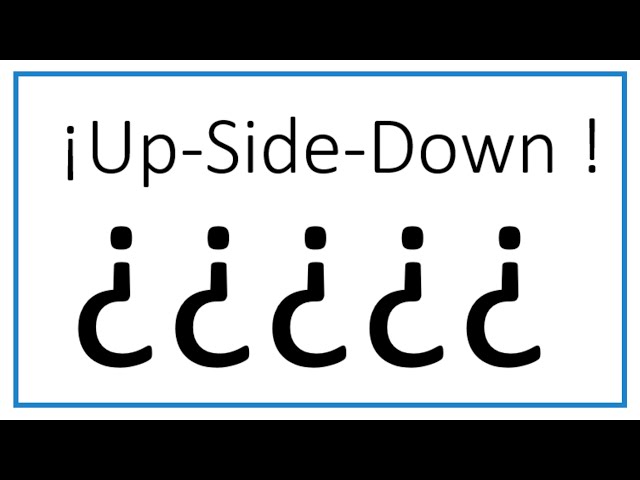
The inverted query mark () is a punctuation mark utilized in Spanish and different languages to point the start of a query. It’s positioned in the beginning of a query and is adopted by an everyday query mark (?) on the finish. For instance: Cmo ests? (How are you?)
The inverted query mark is necessary as a result of it helps readers to establish the start of a query, even when they don’t seem to be acquainted with the language. It is usually used to point rhetorical questions, that are questions that aren’t meant to be answered. For instance: Por qu me haces esto? (Why are you doing this to me?)
The inverted query mark has been utilized in Spanish because the 18th century. It’s thought to have originated from the observe of writing a query mark backwards as a technique to point out that the query was rhetorical. Over time, the backwards query mark grew to become standardized because the inverted query mark.
The Inverted Query Mark
The inverted query mark is a punctuation mark utilized in Spanish and different languages to point the start of a query. It’s positioned in the beginning of a query and is adopted by an everyday query mark (?) on the finish. For instance: ¿Cómo estás? (How are you?)
- Origin: The inverted query mark originated within the 18th century as a technique to point out rhetorical questions.
- Operate: It helps readers to establish the start of a query, even when they don’t seem to be acquainted with the language.
- Utilization: It’s utilized in Spanish and different languages, equivalent to Catalan, Galician, and Basque.
- Form: It’s an inverted query mark, with the hook on the backside.
- Keyboard: On most Spanish keyboards, it may be accessed by urgent the important thing mixture Alt Gr + ?.
- Unicode: The Unicode code for the inverted query mark is U+00BF.
- HTML: The HTML code for the inverted query mark is ¿.
- CSS: The CSS property for the inverted query mark is content material: “27E6”;.
- Instance: ¿Qué hora es? (What time is it?)
The inverted query mark is a crucial punctuation mark in Spanish and different languages. It helps readers to establish the start of a query and can be utilized to point rhetorical questions. It’s a great tool for writers and translators, and you will need to be acquainted with its utilization.
Origin
The inverted query mark is a punctuation mark that’s used to point the start of a query in Spanish and different languages. It’s positioned in the beginning of a query and is adopted by an everyday query mark (?) on the finish. The inverted query mark originated within the 18th century as a technique to point out rhetorical questions, that are questions that aren’t meant to be answered. Over time, the inverted query mark got here for use for all sorts of questions, not simply rhetorical questions.
- Origins: The inverted query mark originated within the 18th century as a technique to point out rhetorical questions. This was doubtless carried out to make it simpler for readers to establish rhetorical questions, which aren’t meant to be answered.
- Operate: The inverted query mark is used to point the start of a query in Spanish and different languages. It’s positioned in the beginning of a query and is adopted by an everyday query mark (?) on the finish.
- Utilization: The inverted query mark is utilized in Spanish and different languages, equivalent to Catalan, Galician, and Basque. It is usually utilized in another languages, equivalent to Turkish and Azerbaijani.
- Form: The inverted query mark is an inverted query mark, with the hook on the backside.
The inverted query mark is a crucial punctuation mark in Spanish and different languages. It helps readers to establish the start of a query and can be utilized to point rhetorical questions. It’s a great tool for writers and translators, and you will need to be acquainted with its utilization.
Operate
The inverted query mark is a punctuation mark that’s used to point the start of a query in Spanish and different languages. It’s positioned in the beginning of a query and is adopted by an everyday query mark (?) on the finish. The inverted query mark helps readers to establish the start of a query, even when they don’t seem to be acquainted with the language.
- Readability: The inverted query mark makes it clear that the next textual content is a query, even when the reader just isn’t acquainted with the language. That is particularly useful for readers who’re studying a brand new language or who’re studying a textual content that’s in a unique language from their very own.
- Recognition: The inverted query mark is a well-known image that’s acknowledged by readers of all languages. This makes it an efficient technique to point out the start of a query, whatever the reader’s language background.
- Universality: The inverted query mark is utilized in many alternative languages, together with Spanish, Catalan, Galician, Basque, Turkish, and Azerbaijani. This makes it a common image that can be utilized to point the start of a query in any language.
The inverted query mark is a crucial punctuation mark that helps readers to establish the start of a query, even when they don’t seem to be acquainted with the language. It’s a clear, recognizable, and common image that can be utilized to point the start of a query in any language.
Utilization
The inverted query mark is utilized in Spanish and different languages, equivalent to Catalan, Galician, and Basque, to point the start of a query. That is necessary as a result of it helps readers to establish the start of a query, even when they don’t seem to be acquainted with the language. The inverted query mark is a transparent and recognizable image that’s used to point the start of a query in many alternative languages.
For instance, in Spanish, the inverted query mark is used to point the start of a query, equivalent to within the following sentence:
¿Cómo estás? (How are you?)
In Catalan, the inverted query mark can be used to point the start of a query, equivalent to within the following sentence:
¿Com estàs? (How are you?)
The inverted query mark is a great tool for writers and translators, because it helps readers to establish the start of a query, whatever the language.
In conclusion, the inverted query mark is a crucial punctuation mark that’s utilized in Spanish and different languages to point the start of a query. It’s a clear and recognizable image that helps readers to establish the start of a query, whatever the language.
Form
The form of the inverted query mark is important as a result of it’s what distinguishes it from an everyday query mark. The hook on the backside of the inverted query mark is what signifies that the next textual content is a query. That is necessary as a result of it helps readers to establish the start of a query, even when they don’t seem to be acquainted with the language.
- Readability: The form of the inverted query mark makes it clear that the next textual content is a query. That is particularly useful for readers who’re studying a brand new language or who’re studying a textual content that’s in a unique language from their very own.
- Recognition: The form of the inverted query mark is a well-known image that’s acknowledged by readers of all languages. This makes it an efficient technique to point out the start of a query, whatever the reader’s language background.
- Universality: The form of the inverted query mark is utilized in many alternative languages, together with Spanish, Catalan, Galician, Basque, Turkish, and Azerbaijani. This makes it a common image that can be utilized to point the start of a query in any language.
In conclusion, the form of the inverted query mark is important as a result of it helps readers to establish the start of a query, even when they don’t seem to be acquainted with the language. It’s a clear, recognizable, and common image that can be utilized to point the start of a query in any language.
Keyboard
The keyboard shortcut for typing the inverted query mark on a Spanish keyboard is Alt Gr + ?. It is a handy technique to sort the inverted query mark, because it doesn’t require the usage of any particular characters or symbols. The Alt Gr key’s sometimes situated to the precise of the house bar on Spanish keyboards.
- Ease of Use: The keyboard shortcut makes it simple to sort the inverted query mark, because it doesn’t require the usage of any particular characters or symbols. That is particularly helpful for people who find themselves not acquainted with the Spanish keyboard format.
- Effectivity: The keyboard shortcut is a fast and environment friendly technique to sort the inverted query mark. This may be helpful for individuals who must sort a variety of inverted query marks, equivalent to writers and translators.
- Consistency: The keyboard shortcut is constant throughout all Spanish keyboards. Because of this folks can use the identical keyboard shortcut to sort the inverted query mark no matter the kind of Spanish keyboard they’re utilizing.
Total, the keyboard shortcut for typing the inverted query mark on a Spanish keyboard is a handy, environment friendly, and constant technique to sort this character. It’s a helpful shortcut for individuals who must sort a variety of inverted query marks, equivalent to writers and translators.
Unicode
The Unicode code for the inverted query mark is U+00BF. Unicode is a computing business customary for the constant encoding, illustration, and dealing with of textual content expressed in a lot of the world’s writing methods. The Unicode Customary defines a singular code for each character, whatever the platform, system, software, or language. This enables characters to be represented and exchanged constantly throughout completely different methods and functions.
- Character Encoding: The Unicode code for the inverted query mark permits it to be represented and exchanged constantly throughout completely different methods and functions. That is necessary for making certain that the inverted query mark is displayed appropriately in numerous contexts, equivalent to on web sites, in paperwork, and in software program functions.
- Cross-Platform Compatibility: The Unicode code for the inverted query mark ensures that it may be used on completely different platforms and gadgets. That is necessary for making certain that the inverted query mark can be utilized in a wide range of functions, equivalent to phrase processors, net browsers, and electronic mail purchasers.
- Language Independence: The Unicode code for the inverted query mark is impartial of any specific language. Because of this the inverted query mark can be utilized in any language that makes use of the Unicode customary.
- Internationalization: The Unicode code for the inverted query mark is a part of the Unicode customary, which is a world customary for character encoding. Because of this the inverted query mark can be utilized in any nation or area that makes use of the Unicode customary.
Total, the Unicode code for the inverted query mark is necessary for making certain that it may be represented and exchanged constantly throughout completely different methods, platforms, and languages. That is important for the widespread use of the inverted query mark in a wide range of functions and contexts.
HTML
The HTML code for the inverted query mark, ¿, is a crucial software for representing the inverted query mark in net pages and different digital content material. It permits customers to simply show the inverted query mark in net browsers and different functions that help HTML.
- Character Illustration: The HTML code for the inverted query mark permits customers to characterize the inverted query mark in digital content material. That is necessary for making certain that the inverted query mark is displayed appropriately in net pages and different digital content material.
- Cross-Browser Compatibility: The HTML code for the inverted query mark is supported by all main net browsers. This ensures that the inverted query mark will probably be displayed appropriately in net pages whatever the browser that’s getting used.
- Internationalization: The HTML code for the inverted query mark is a part of the HTML customary, which is a world customary for net content material. Because of this the inverted query mark can be utilized in net pages whatever the language or area.
- Unicode Compatibility: The HTML code for the inverted query mark is suitable with Unicode, which is a computing business customary for the constant encoding, illustration, and dealing with of textual content expressed in a lot of the world’s writing methods. This ensures that the inverted query mark can be utilized in net pages alongside textual content from any language.
Total, the HTML code for the inverted query mark is a crucial software for representing the inverted query mark in net pages and different digital content material. It permits customers to simply show the inverted query mark in net browsers and different functions that help HTML, and it ensures that the inverted query mark is displayed appropriately whatever the browser or platform that’s getting used.
CSS
The CSS property content material means that you can insert generated content material, such because the inverted query mark, into a component. The worth "27E6" is the Unicode code level for the inverted query mark. This property is helpful for including ornamental components or icons to an internet web page with out having to make use of photos.
- Instance: The next CSS code will add an inverted query mark earlier than every heading on an internet web page:
“`cssh1:earlier than { content material: “27E6”; margin-right: 5px;}“` Compatibility: The content material property is supported by all main net browsers. Utilization: The content material property can be utilized so as to add any sort of generated content material to a component, together with textual content, photos, or icons. It’s usually used so as to add ornamental components or icons to an internet web page with out having to make use of photos.
The content material property is a strong software that can be utilized so as to add a wide range of components to an internet web page. It’s a helpful property for including ornamental components or icons to an internet web page with out having to make use of photos.
Instance
The instance supplied, “¿Qué hora es? (What time is it?)”, demonstrates the utilization of the inverted query mark in Spanish to point the start of a query. The inverted query mark is positioned in the beginning of the query and is adopted by an everyday query mark on the finish. This conference helps readers to establish the start of a query, even when they don’t seem to be acquainted with the Spanish language.
The inverted query mark is a crucial a part of Spanish grammar and punctuation. It helps to make clear the intent of a sentence and to make it simpler for readers to grasp the textual content. With out the inverted query mark, it could be tougher to establish the start of a query, which might result in confusion.
Along with its grammatical perform, the inverted query mark will also be used for ornamental functions. For instance, it may be used to create ornamental borders or to focus on necessary textual content. It will also be used to create a way of playfulness or whimsy.
Total, the inverted query mark is a flexible and helpful punctuation mark that performs an necessary function in Spanish grammar and punctuation. It’s a priceless software for writers and translators, and you will need to be acquainted with its utilization.
FAQs concerning the Inverted Query Mark
The inverted query mark is a punctuation mark utilized in Spanish and different languages to point the start of a query. It’s positioned in the beginning of a query and is adopted by an everyday query mark (?) on the finish. The inverted query mark may be complicated for people who find themselves not acquainted with the language, so listed here are some FAQs about its utilization:
Query 1: Why is the query mark the wrong way up?
Reply: The inverted query mark originated within the 18th century as a technique to point out rhetorical questions. Over time, it got here for use for all sorts of questions, not simply rhetorical questions.
Query 2: When ought to I exploit the inverted query mark?
Reply: The inverted query mark ought to be used in the beginning of a query in Spanish and different languages that use it, equivalent to Catalan, Galician, and Basque.
Query 3: How do I sort the inverted query mark?
Reply: On most Spanish keyboards, the inverted query mark may be typed by urgent the important thing mixture Alt Gr + ?. You can too use the Unicode code U+00BF or the HTML code ¿.
Query 4: What’s the distinction between the inverted query mark and the common query mark?
Reply: The inverted query mark is positioned in the beginning of a query, whereas the common query mark is positioned on the finish. The inverted query mark can be utilized in Spanish and different languages, whereas the common query mark is utilized in English and most different languages.
Query 5: Can I exploit the inverted query mark in English?
Reply: No, the inverted query mark just isn’t utilized in English. In English, the common query mark (?) is used on the finish of a query.
Query 6: Is the inverted query mark necessary?
Reply: Sure, the inverted query mark is a crucial punctuation mark in Spanish and different languages. It helps readers to establish the start of a query, which may be particularly useful for people who find themselves not acquainted with the language.
Abstract: The inverted query mark is a punctuation mark that’s utilized in Spanish and different languages to point the start of a query. You will need to use the inverted query mark appropriately with the intention to keep away from confusion.
Transition to the subsequent article part: Now that extra concerning the inverted query mark, you’ll be able to be taught extra about different punctuation marks utilized in Spanish.
Ideas for Utilizing the Inverted Query Mark
The inverted query mark is a punctuation mark that’s utilized in Spanish and different languages to point the start of a query. You will need to use the inverted query mark appropriately with the intention to keep away from confusion. Listed here are some suggestions for utilizing the inverted query mark:
Tip 1: Use the inverted query mark in the beginning of a query.
The inverted query mark ought to be positioned in the beginning of a query, earlier than every other phrases. For instance:
Cmo ests? (How are you?)
Tip 2: Use an everyday query mark on the finish of a query.
The inverted query mark is all the time adopted by an everyday query mark on the finish of the query. For instance:
Qu hora es? (What time is it?)
Tip 3: Don’t use the inverted query mark in English.
The inverted query mark just isn’t utilized in English. In English, the common query mark (?) is used on the finish of a query.
Tip 4: Use the inverted query mark in Spanish and different languages that use it.
The inverted query mark is utilized in Spanish and different languages, equivalent to Catalan, Galician, and Basque. When writing in these languages, make sure to use the inverted query mark in the beginning of questions.
Tip 5: Be constant together with your use of the inverted query mark.
When you begin utilizing the inverted query mark, be constant together with your utilization. Use it in the beginning of all questions in Spanish and different languages that use it.
Abstract: The inverted query mark is a punctuation mark that’s utilized in Spanish and different languages to point the start of a query. You will need to use the inverted query mark appropriately with the intention to keep away from confusion. By following the following tips, you’ll be able to guarantee that you’re utilizing the inverted query mark appropriately.
Transition to the article’s conclusion: Now that you understand how to make use of the inverted query mark, you’ll be able to be taught extra about different punctuation marks utilized in Spanish.
Conclusion
The inverted query mark is a punctuation mark that’s utilized in Spanish and different languages to point the start of a query. You will need to use the inverted query mark appropriately with the intention to keep away from confusion. By following the ideas outlined on this article, you’ll be able to guarantee that you’re utilizing the inverted query mark appropriately.
The inverted query mark is a priceless software for writers and translators. It helps readers to establish the start of a query, which may be particularly useful for people who find themselves not acquainted with the language. By utilizing the inverted query mark appropriately, you can also make your writing extra clear and comprehensible.
Youtube Video: