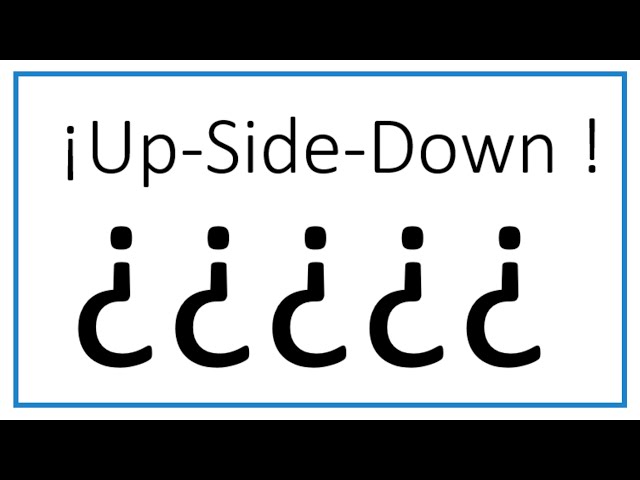
The upside-down query mark, also referred to as an inverted query mark, is a punctuation mark utilized in Spanish and several other different languages to indicate the start of an interrogative sentence. It’s written as an upside-down query mark (?) and is positioned at first of a sentence, earlier than the topic. For instance, in Spanish, the sentence “Cmo ests?” means “How are you?”
The upside-down query mark is essential as a result of it helps readers to determine the start of a query. It additionally helps to tell apart between questions and statements, which could be essential in languages the place the phrase order is completely different from English. For instance, in Spanish, the sentence “Ests bien?” means “Are you okay?” If the query mark weren’t the wrong way up, it could be tough to inform whether or not the sentence was a query or an announcement.
The upside-down query mark has been used for hundreds of years in Spanish and different languages. It’s a helpful punctuation mark that helps to make writing clear and straightforward to know.
the wrong way up query mark
The upside-down query mark, also referred to as an inverted query mark, is a punctuation mark utilized in Spanish and several other different languages to indicate the start of an interrogative sentence. It’s written as an upside-down query mark (?) and is positioned at first of a sentence, earlier than the topic.
- Punctuation mark
- Starting of a query
- Spanish and different languages
- Inverted query mark
- Interrogative sentence
- Distinguishes questions from statements
- Helps readers determine questions
- Used for hundreds of years
- Helpful punctuation mark
- Makes writing clear and straightforward to know
These key facets spotlight the significance and utilization of the upside-down query mark in numerous dimensions. It serves as a punctuation mark that denotes the start of a query, primarily utilized in Spanish and different languages. Its distinctive inverted kind helps distinguish questions from statements, aiding readers in figuring out the intent of a sentence. The upside-down query mark has been employed for hundreds of years, showcasing its established position in written communication. It stays a helpful instrument for making writing clear and understandable, significantly in languages the place phrase order differs from English.
Punctuation mark
A punctuation mark is a written image that’s used to separate phrases, phrases, and clauses in a sentence. Punctuation marks assist to make writing clear and straightforward to know. The upside-down query mark is a punctuation mark that’s utilized in Spanish and several other different languages to indicate the start of an interrogative sentence.
-
Separator
The upside-down query mark is used to separate the start of a query from the remainder of the sentence. This helps to make it clear to the reader that the sentence is a query.
-
Clarifier
The upside-down query mark helps to make clear the that means of a sentence. By indicating that the sentence is a query, it helps the reader to know the intent of the author.
-
Indicator
The upside-down query mark is an indicator of the kind of sentence that’s getting used. It tells the reader that the sentence is a query, slightly than an announcement or an exclamation.
The upside-down query mark is a helpful punctuation mark that helps to make writing clear and straightforward to know. It is a crucial a part of the Spanish language and is utilized in a wide range of contexts.
Starting of a query
In written language, the start of a query is often indicated by a query mark. Nevertheless, in Spanish and several other different languages, an upside-down query mark is used to indicate the start of an interrogative sentence. This distinctive punctuation mark serves a number of essential capabilities, together with:
-
Signaling a query
The upside-down query mark is a transparent and concise technique to sign to the reader that the sentence that follows is a query. This helps to keep away from confusion and ensures that the reader can interpret the sentence accurately.
-
Distinguishing questions from statements
In languages the place the phrase order of questions and statements is identical, the upside-down query mark performs a vital position in distinguishing between the 2. That is particularly essential in written textual content, the place the reader can not depend on intonation or different cues to find out the intent of the sentence.
-
Including emphasis
In some instances, the upside-down query mark can be utilized so as to add emphasis to a query. That is typically achieved in rhetorical questions or questions which might be supposed to be provocative or difficult.
-
Creating a way of anticipation
The upside-down query mark may also create a way of anticipation or suspense within the reader. It’s because it alerts that the sentence that follows is prone to comprise essential info or a shocking revelation.
The upside-down query mark is a helpful punctuation mark that performs an essential position in Spanish and several other different languages. It helps to sign questions, distinguish them from statements, add emphasis, and create a way of anticipation. Consequently, it’s a necessary instrument for clear and efficient communication.
Spanish and different languages
The upside-down query mark, also referred to as an inverted query mark, is a punctuation mark utilized in Spanish and several other different languages to indicate the start of an interrogative sentence. Its presence in numerous languages highlights the mark’s significance and the varied linguistic contexts wherein it’s employed.
-
Spanish
In Spanish, the upside-down query mark is a necessary a part of the language’s grammar. It’s used to point the start of all questions, no matter their construction or complexity. This helps to make sure readability and prevents confusion between questions and statements.
-
Portuguese
Much like Spanish, Portuguese additionally makes use of the upside-down query mark to mark the start of interrogative sentences. This mark is essential for distinguishing questions from declarative sentences, which might have an analogous construction.
-
Catalan
The upside-down query mark is prevalent in Catalan, a Romance language spoken in Catalonia, Spain. It serves the identical perform as in Spanish and Portuguese, aiding within the identification and comprehension of questions.
-
Guarani
Guarani, an indigenous language spoken in Paraguay and components of South America, employs the upside-down query mark to mark interrogative sentences. Its utilization aligns with the grammatical conventions of the language and facilitates efficient communication.
The presence of the upside-down query mark in Spanish and different languages underscores its significance as a punctuation mark that enhances readability and facilitates comprehension. Its constant utilization throughout numerous linguistic contexts demonstrates its effectiveness in marking interrogative sentences and aiding within the interpretation of written textual content.
Inverted query mark
The inverted query mark, also referred to as the upside-down query mark, is a punctuation mark utilized in Spanish and several other different languages to indicate the start of an interrogative sentence. It’s written as an upside-down query mark (?) and is positioned at first of a sentence, earlier than the topic.
-
Punctuation mark
The inverted query mark is a punctuation mark that’s used to point the start of a query. It’s just like the query mark (?) that’s utilized in English and different languages, however it’s inverted.
-
Starting of a query
The inverted query mark is positioned at first of a sentence to point that the sentence is a query. This helps readers to determine questions and to tell apart them from statements.
-
Spanish and different languages
The inverted query mark is utilized in Spanish and several other different languages, together with Portuguese, Catalan, and Guarani. It isn’t utilized in English or different Germanic languages.
-
Interrogative sentence
An interrogative sentence is a sentence that asks a query. The inverted query mark is used to point {that a} sentence is interrogative.
The inverted query mark is a helpful punctuation mark that helps to make writing clear and straightforward to know. It is a crucial a part of the Spanish language and is utilized in a wide range of contexts.
Interrogative sentence
An interrogative sentence is a sentence that asks a query. It’s usually characterised by a query mark (?) on the finish of the sentence. In some languages, similar to Spanish, an upside-down query mark (?) is used at first of the sentence to point that it’s a query.
The upside-down query mark is carefully related to the interrogative sentence as a result of it serves as a visible cue that the sentence is a query. That is particularly essential in languages the place the phrase order of questions and statements is identical. For instance, within the Spanish sentence “Cmo ests?”, the upside-down query mark at first of the sentence tells the reader that the sentence is a query, despite the fact that the phrase order is identical as it could be in an announcement.
The upside-down query mark can be essential for distinguishing between direct and oblique questions. A direct query is a query that’s requested on to somebody, whereas an oblique query is a query that’s reported not directly. In Spanish, direct questions are usually marked with an upside-down query mark at first of the sentence, whereas oblique questions should not.
The upside-down query mark is a helpful punctuation mark that helps to make writing clear and straightforward to know. It is a crucial a part of the Spanish language and is utilized in a wide range of contexts.
Distinguishes questions from statements
The “the wrong way up query mark” is a punctuation mark utilized in Spanish and several other different languages to indicate the start of an interrogative sentence. It’s written as an upside-down query mark (?) and is positioned at first of a sentence, earlier than the topic. One of many key capabilities of the upside-down query mark is that it helps to tell apart questions from statements.
In languages the place the phrase order of questions and statements is identical, the upside-down query mark performs a vital position in serving to readers to determine the intent of a sentence. For instance, in Spanish, the sentence “Cmo ests?” means “How are you?” If the query mark weren’t the wrong way up, it could be tough to inform whether or not the sentence was a query or an announcement.
The power to tell apart questions from statements is crucial for clear and efficient communication. It helps readers to know the author’s intent and to reply appropriately. The upside-down query mark is a helpful instrument that helps to make this distinction clear.
Helps readers determine questions
The “the wrong way up query mark” is a punctuation mark utilized in Spanish and several other different languages to indicate the start of an interrogative sentence. It’s written as an upside-down query mark (?) and is positioned at first of a sentence, earlier than the topic. One of many key capabilities of the upside-down query mark is that it helps readers to determine questions.
-
Readability and distinction
In languages the place the phrase order of questions and statements is identical, the upside-down query mark performs a vital position in serving to readers to determine the intent of a sentence. For instance, in Spanish, the sentence “Cmo ests?” means “How are you?” If the query mark weren’t the wrong way up, it could be tough to inform whether or not the sentence was a query or an announcement.
-
Visible cue
The upside-down query mark serves as a visible cue that helps readers to determine questions. That is particularly essential in languages the place the phrase order of questions and statements is just not fastened. For instance, in English, the sentence “Are you okay?” is a query, however the sentence “You’re okay” is an announcement. The upside-down query mark helps readers to tell apart between these two kinds of sentences.
-
Intonation and context
In some languages, intonation and context can be utilized to tell apart between questions and statements. Nevertheless, in written textual content, this isn’t at all times attainable. The upside-down query mark supplies a transparent and unambiguous technique to point out {that a} sentence is a query.
The upside-down query mark is a helpful instrument that helps readers to determine questions. It’s a necessary a part of the writing system in lots of languages and helps to make communication clear and efficient.
Used for hundreds of years
The “the wrong way up query mark” has been used for hundreds of years to indicate the start of an interrogative sentence. It’s a helpful punctuation mark that helps to make writing clear and straightforward to know. There are a number of the explanation why the the wrong way up query mark has been used for thus lengthy.
-
Historic Priority
The the wrong way up query mark has been used for hundreds of years, courting again to the Center Ages. It’s believed to have originated in Spain, the place it was used to mark questions in authorized and non secular texts. Over time, the the wrong way up query mark unfold to different languages, together with Portuguese, Catalan, and Guarani.
-
Readability and Distinction
The the wrong way up query mark helps to make writing clear and straightforward to know. It supplies a visible cue that lets readers know {that a} sentence is a query. That is particularly essential in languages the place the phrase order of questions and statements is identical. For instance, in Spanish, the sentence “Cmo ests?” means “How are you?” If the query mark weren’t the wrong way up, it could be tough to inform whether or not the sentence was a query or an announcement.
-
Standardization
The the wrong way up query mark has turn out to be standardized in lots of languages. Which means that it’s used constantly throughout various kinds of writing, from newspapers and magazines to books and web sites. Standardization helps to make sure that readers can simply determine questions, whatever the context wherein they seem.
The the wrong way up query mark is a helpful punctuation mark that has been used for hundreds of years. It helps to make writing clear and straightforward to know, and it’s standardized in lots of languages. Consequently, it’s prone to proceed for use for a few years to return.
Helpful punctuation mark
The “the wrong way up query mark” is a helpful punctuation mark that’s utilized in Spanish and several other different languages. It’s written as an upside-down query mark (?) and is positioned at first of a sentence, earlier than the topic. The upside-down query mark serves a number of essential capabilities, together with:
-
Readability and distinction
The upside-down query mark helps to make writing clear and straightforward to know. It supplies a visible cue that lets readers know {that a} sentence is a query. That is particularly essential in languages the place the phrase order of questions and statements is identical. For instance, in Spanish, the sentence “Cmo ests?” means “How are you?” If the query mark weren’t the wrong way up, it could be tough to inform whether or not the sentence was a query or an announcement.
-
Consistency and standardization
The upside-down query mark is standardized in lots of languages. Which means that it’s used constantly throughout various kinds of writing, from newspapers and magazines to books and web sites. Standardization helps to make sure that readers can simply determine questions, whatever the context wherein they seem.
-
Historic significance
The upside-down query mark has been used for hundreds of years in Spanish and different languages. Its historic significance provides to its worth as a punctuation mark, because it has stood the take a look at of time and continues to be an essential a part of written communication.
-
Cross-linguistic communication
The upside-down query mark is utilized in a number of completely different languages, together with Spanish, Portuguese, Catalan, and Guarani. This makes it a helpful instrument for cross-linguistic communication, as it may be used to point questions in a wide range of languages.
The upside-down query mark is a helpful punctuation mark that performs an essential position in written communication. It helps to make writing clear and straightforward to know, and it’s standardized in lots of languages. Consequently, it’s prone to proceed for use for a few years to return.
Makes writing clear and straightforward to know
The upside-down query mark (?) is a punctuation mark that’s utilized in Spanish and several other different languages to indicate the start of an interrogative sentence. It’s written as an upside-down query mark (?) and is positioned at first of a sentence, earlier than the topic. The upside-down query mark serves a number of essential capabilities, however one in all its most essential capabilities is that it helps to make writing clear and straightforward to know.
In languages the place the phrase order of questions and statements is identical, the upside-down query mark performs a vital position in serving to readers to determine the intent of a sentence. For instance, in Spanish, the sentence “Cmo ests?” means “How are you?” If the query mark weren’t the wrong way up, it could be tough to inform whether or not the sentence was a query or an announcement.
The upside-down query mark additionally helps to make writing extra concise and environment friendly. By indicating {that a} sentence is a query, the upside-down query mark eliminates the necessity for the author to make use of different phrases or phrases to sign the query, similar to “Do you” or “Are you able to please inform me.” This will help to make writing extra streamlined and simpler to learn.
The upside-down query mark is a helpful punctuation mark that helps to make writing clear, straightforward to know, and concise. It is a crucial a part of the writing system in lots of languages and helps to make communication simpler.
FAQs in regards to the Upside-Down Query Mark
The upside-down query mark (?) is a punctuation mark utilized in Spanish and several other different languages to indicate the start of an interrogative sentence. It’s written as an upside-down query mark (?) and is positioned at first of a sentence, earlier than the topic. The upside-down query mark serves a number of essential capabilities, however one in all its most essential capabilities is that it helps to make writing clear and straightforward to know.
Query 1: What’s the upside-down query mark?
The upside-down query mark is a punctuation mark that’s utilized in Spanish and several other different languages to indicate the start of an interrogative sentence.
Query 2: How is the upside-down query mark used?
The upside-down query mark is positioned at first of a sentence, earlier than the topic, to point that the sentence is a query.
Query 3: Why is the upside-down query mark essential?
The upside-down query mark is essential as a result of it helps to make writing clear and straightforward to know. It supplies a visible cue that lets readers know {that a} sentence is a query.
Query 4: By which languages is the upside-down query mark used?
The upside-down query mark is utilized in Spanish, Portuguese, Catalan, Guarani, and several other different languages.
Query 5: What are some examples of the upside-down query mark in use?
Listed here are some examples of the upside-down query mark in use:
- Cmo ests? (Spanish)
- Como vai? (Portuguese)
- Com va? (Catalan)
- Ha’e voi? (Guarani)
Query 6: How can I be taught extra in regards to the upside-down query mark?
You’ll be able to be taught extra in regards to the upside-down query mark by studying books and articles about Spanish and different languages that use this punctuation mark. You too can discover extra info on-line.
The upside-down query mark is a helpful punctuation mark that helps to make writing clear and straightforward to know. It is a crucial a part of the writing system in lots of languages and helps to make communication simpler.
Transition to the subsequent article part:
Click on right here to be taught extra about Spanish grammar.
Suggestions for Utilizing the Upside-Down Query Mark
The upside-down query mark is a helpful punctuation mark that may assist to make your writing clear and straightforward to know. Listed here are a number of suggestions for utilizing it accurately:
Tip 1: Use it at first of a query.
The upside-down query mark must be positioned at first of a sentence to point that it’s a query. For instance:
- Cmo ests? (Spanish)
- Como vai? (Portuguese)
- Com va? (Catalan)
Tip 2: Use it even when the phrase order is identical as an announcement.
In some languages, similar to Spanish, the phrase order of questions and statements is identical. In these instances, it’s particularly essential to make use of the upside-down query mark to point that the sentence is a query. For instance:
- T hablas espaol? (Spanish)
- Voc fala espanhol? (Portuguese)
- Parles catal? (Catalan)
Tip 3: Do not use it on the finish of a query.
The upside-down query mark ought to solely be used at first of a query. Don’t use it on the finish of a query. For instance:
- Cmo ests? (right)
- Cmo ests? (incorrect)
Tip 4: Use it constantly.
Be constant in your use of the upside-down query mark. Use it at first of all questions, even when the phrase order is identical as an announcement. This may assist to make your writing clear and straightforward to know.
Tip 5: Study the foundations in your language.
The foundations for utilizing the upside-down query mark might range relying on the language you might be writing in. Be sure you be taught the foundations in your language as a way to use the upside-down query mark accurately.
Abstract:
The upside-down query mark is a helpful punctuation mark that may assist to make your writing clear and straightforward to know. By following the following tips, you should use the upside-down query mark accurately and successfully.
Transition to the article’s conclusion:
Click on right here to be taught extra about Spanish grammar.
Conclusin
El signo de interrogacin invertido es un signo de puntuacin valioso que ayuda a que la escritura sea clara y fcil de entender. Es una parte importante del sistema de escritura en muchos idiomas y ayuda a que la comunicacin sea ms eficaz.
En este artculo, hemos explorado el signo de interrogacin invertido, sus usos y su importancia. Hemos proporcionado ejemplos de su uso en diferentes idiomas y hemos ofrecido consejos para utilizarlo correctamente.
Youtube Video: